For information on the → legal situation see below.
The scientific examination of moral questions plays an important role in medicine. Research on new technologies, their application, and the framework conditions to be considered always go hand in hand with questions of normative classification. Stem cell research, in particular, has always been accompanied by complex and, in some cases, highly controversial ethical debates since the beginnings of this field of research. It is essential to conduct these debates transparently and to face them again and again, especially in societies with different worldviews and concepts of life. Only in this manner can ways be found for dealing with new technologies that will also be sustainably supported by society.
→ Destruction of human embryos
→ Translation of new research findings
→ Expectation management / unproven therapies
→ Related topics
Destruction of human embryos
The question of the importance of early human life played particularly in the early debate on stem cell research an important role, but it is still being discussed today. Although reprogramming somatic cells (cf. → induced pluripotent stem cells) is now a very good alternative to using embryonic stem cells, many research approaches still depend on the use of human embryonic stem cells, for the production of which human embryos were destroyed at the beginning (cf. → embryonic stem cells). However, it is not necessary to obtain new embryonic stem cells for every research question; it is possible to fall back on already established stem cell lines as embryonic stem cells can be multiplied again and again in culture conditions.
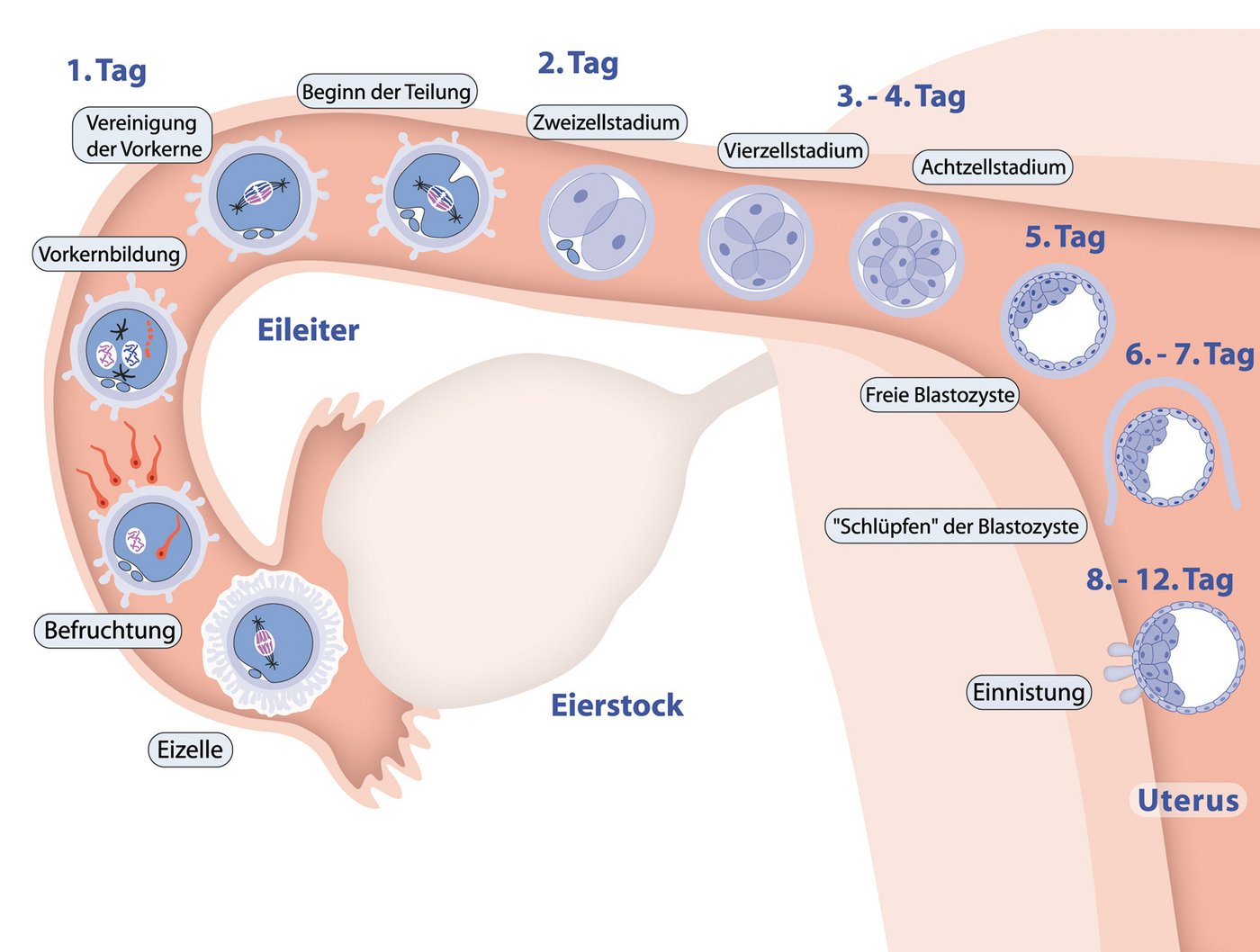
Fig.1: When does the human embryo become a human being in the moral sense? The figure shows the developmental stages from the (fertilized) egg to its implantation in the uterus (in German). The blastocyst stage, i.e. before implantation into the uterus, is required for the derivation of embryonic stem cells. The inner cell mass is the embryonic stem cells.
The question as to whether the human embryo is worthy of protection lies at the center of the ethical discussion. Does this allow embryos to be used to derive stem cells or even to be created only for this purpose? There is no global answer to this question. In some countries, such as Germany, the derivation of embryonic stem cells is prohibited; in other legal systems, only what are known as surplus embryos from fertility treatments may be used for research. Other legal systems permit the creation and destruction of human embryos specifically for research purposes. Ultimately, these regulations always raise questions about the moral status of early human life. When does the human embryo become a human being in the moral sense? From fertilization, from implantation in the uterus, from a certain stage of development or, for example, only from birth? A proven method of ethically evaluating an action is to ask about the legitimacy of both the objectives pursued by the action and the means used. Since the justifiability of the means also depends on what other means are available, the question of possible alternatives plays an important role.
You can find a more detailed description of many core questions relating to stem cell research ➚ here.
Translation of new research findings
Stem cell research has since developed beyond the stage of pure basic research. The first clinically tested therapies with stem cells are approved and many other therapeutic approaches are under development. With the increase in clinical trials, the involvement of clinical ethics committees in the approval process for stem cell-based applications is becoming increasingly important.
Tissue databases are being created for stem cell research, particularly for research on induced pluripotent stem cells. But what rights do the original tissue donors have to the processed cell cultures and how are they to be involved appropriately in the research results? Should tissue donors be informed when research reveals abnormalities in their tissue samples?
Non-therapeutic applications of stem cell research are also pursued, such as the production of meat from petridishes or the testing of new drugs. Such developments always raise further ethically relevant questions. For example, cultures from human stem cells or iPS cells could be used to test drugs and active substances and thus contribute to reducing the number of animal experiments.
The production of meat from animal muscle stem cells has been possible for some time. Research and industry worldwide are now working on the marketability of lab-grown meat. The normative effects, for example with regard to animal welfare and climate protection, are enormous. These and many other questions will have to be discussed in the coming years by normative scientists, political decision-makers, and the public.
Expectation management / unproven therapies
The potential of stem cell research has also raised many expectations in society. Patients suffering from severe and previously incurable diseases, in particular, have high hopes of being cured by tissue replacement. Research results to date are very promising and it is assumed that treatment approaches can be developed for a variety of diseases, such as diabetes and Parkinson’s disease, in the medium to long term. At this point, however, it must be emphasized that clinically proven stem cell therapies have so far only been available in a small number of areas (cf. → Which stem cell therapies are available?).
Unfortunately, however, hundreds of commercial providers offering stem cell treatments that have not been clinically tested have now become established worldwide. Such services are often associated with high costs for the patients and a careful evaluation and aftercare do not take place. Many providers of unproven stem cell treatments offer the same treatment approach for a variety of different indications. For example, abdominal fat is removed from the patient, the stem cells contained in it are isolated and then (depending on the disease) retransplanted into the affected tissue. These treatments are not based on reliable clinical data and have not passed the stringent safety and efficacy protocols that apply to the approval of new drugs and treatments. From a scientific point of view, too, the probability of achieving success with such a treatmentis very low. At the same time, such treatments are permissible in some jurisdictions or are at least in a legal gray area. In addition, the ability of physicians and patients to freely choose therapies is of great importance in most legal systems. Finding the right balance between patient autonomy and patient protection and developing functioning mechanisms to ensure treatment quality that leave room for therapeutic innovation area major ethical challenge.
Stem cell research is just one of many fields of biomedical research and is crucially influenced by findings and developments in other research areas. For example, the development of the CRISPR/Cas method for genome editing represents a huge step forward for biomedical research and, at the same time, triggers controversial ethical and legal discussions. The first report from China about the birth of allegedly HIV-immune babies in which the germ cells had previously been genetically modified came at the end of 2018.
The possibility of producing functional germ cells from induced pluripotent stem cells could have a significant effect on reproductive medicine. This technology would make it possible to produce genetic offspring for same-sex couples or even children with only one genetic parent (who are not clones). The normative effects of such developments on the image of the family and the various legal areas cannot yet be foreseen.
The mixture of human and animal genetic material or tissue, which plays a role in some research approaches in the field of stem cell research (e.g. tetraploid complementation or production of organoids), is another field of research with a high need for ethical classification.
In summary, it can be stated that the ethical and social debates in stem cell research are shifting in parallel to the further development of the field of research, but, at the same time, the original questions must not be overlooked. The normative evaluation requires constant readjustment and, simultaneously, a reconnection to fundamental questions. A constant dialog between biomedical research and the ethical, legal, and social science aspects of stem cell research is essential.